
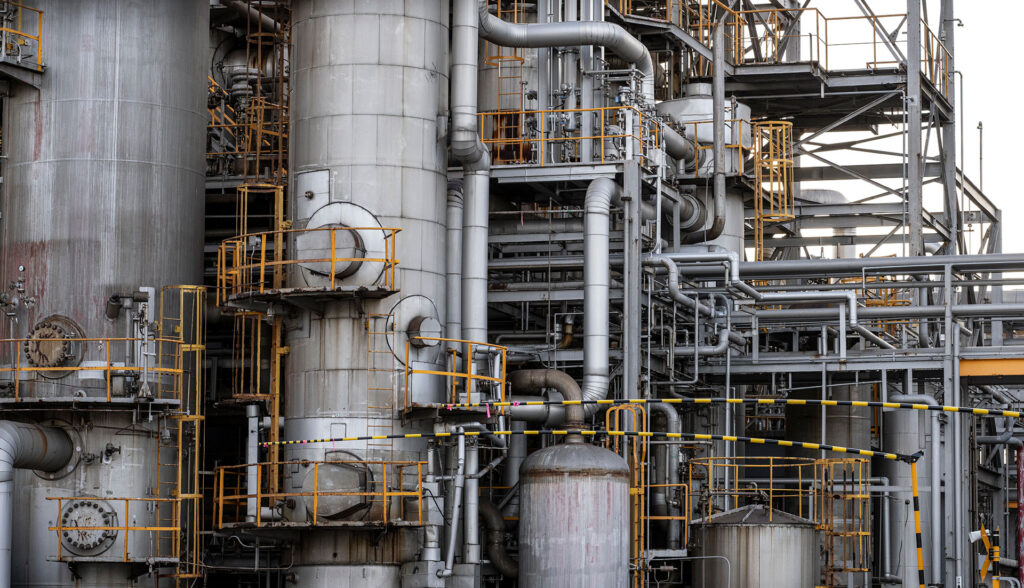
In the ever-evolving field of refinery operations, efficiency and innovation go hand-in-hand. Catalytic reforming units (CRUs), which play a crucial role in producing high-octane gasoline and aromatic hydrocarbons, rely heavily on heat exchange technology for optimal performance. Traditionally, Texas Towers—or Vertical Combined Feed Exchangers (VCFEs)—have been the industry standard. However, modern advancements like Printed Circuit Heat Exchangers (PCHEs) are challenging this norm. In this article, we dive deep into the advantages and disadvantages of both technologies, comparing them across critical criteria such as efficiency, durability, maintenance, and cost-effectiveness.
Overview of Texas Towers
Texas Towers are vertical heat exchangers designed for feed-effluent heat recovery in catalytic reforming units. They are renowned for their ability to handle large-scale heat exchange with relatively straightforward design principles.
Advantages of Texas Towers:
- Proven Technology: Widely used and trusted in the industry for decades.
- Large Capacity: Capable of handling significant volumes of process streams.
- Ease of Integration: Seamlessly integrates with existing refinery setups.
- Cost-Effective Installation: Lower initial investment compared to newer technologies.
Disadvantages of Texas Towers:
- Maintenance Challenges: Prone to fouling due to the accumulation of coke and hydrocarbons, leading to frequent cleaning requirements.
- Space Requirements: Occupy substantial vertical space, which can be a constraint in compact refinery layouts.
- Lower Heat Transfer Efficiency: Limited by design, resulting in higher operational energy costs.
- Downtime Risks: Cleaning and maintenance often require extended shutdowns.
Overview of Printed Circuit Heat Exchangers (PCHEs)
PCHEs represent the forefront of heat exchange technology. These compact units use microchannels etched into metal plates, which are then diffusion-bonded to create a robust and highly efficient structure.
Advantages of PCHEs:
- Superior Heat Transfer Efficiency: Microchannel design maximizes surface area, enabling efficient thermal exchange.
- Compact Design: Up to 85% smaller and lighter than traditional exchangers, saving valuable space.
- High Pressure and Temperature Tolerance: Can withstand pressures exceeding 450 bar (6525 psi) and temperatures up to 900°C.
- Low Maintenance Requirements: Resistant to fouling due to smooth microchannel surfaces.
- Environmental Benefits: Reduced energy consumption leads to lower greenhouse gas emissions.
Disadvantages of PCHEs:
- High Initial Cost: Greater upfront investment compared to Texas Towers.
- Complex Fabrication: Requires specialized manufacturing techniques, which can lead to longer lead times.
- Limited Operational Familiarity: Operators may require additional training to manage and maintain this newer technology.
Comparative Analysis: Texas Towers vs. PCHEs
To determine the best choice for catalytic reforming units, we compare Texas Towers and PCHEs across several key criteria:
1. Heat Transfer Efficiency
- Texas Towers: Moderate efficiency, relying on traditional tubular heat transfer mechanisms.
- PCHEs: Exceptional efficiency due to advanced microchannel designs that maximize thermal exchange.
2. Space Requirements
- Texas Towers: Require significant vertical space, which may limit their applicability in compact facilities.
- PCHEs: Highly compact, allowing for greater flexibility in refinery layouts.
3. Maintenance and Downtime
- Texas Towers: High fouling rates necessitate frequent cleaning, leading to extended downtime.
- PCHEs: Minimal fouling and easier maintenance translate to reduced operational interruptions.
4. Operational Range
- Texas Towers: Effective for moderate temperature and pressure applications, typically up to 400 psi and 700°C.
- PCHEs: Handle extreme conditions, withstanding pressures over 450 bar and temperatures exceeding 900°C.
5. Cost Considerations
- Texas Towers: Lower initial cost but higher operational expenses due to inefficiency and frequent maintenance.
- PCHEs: Higher upfront cost but significant long-term savings through improved efficiency and lower maintenance.
6. Environmental Impact
- Texas Towers: Relatively higher energy consumption and emissions.
- PCHEs: Reduced energy usage aligns with sustainability goals and regulatory compliance.
Which Technology is Right for Your Refinery?
Choosing between Texas Towers and PCHEs depends on your refinery’s specific needs and constraints:
- If Initial Cost is a Priority: Texas Towers are a budget-friendly choice for facilities with moderate requirements.
- If Efficiency and Sustainability are Critical: PCHEs offer unmatched performance and align with long-term cost and environmental goals.
- If Space is Limited: The compact nature of PCHEs makes them ideal for modern, space-constrained refineries.
TEHPA: Your Partner in Refinery Optimization
At TEHPA, we understand the complexities of catalytic reforming units and the importance of selecting the right heat exchange technology. Whether you’re looking to upgrade from Texas Towers or explore the benefits of PCHEs, our team of experts can guide you through the decision-making process. With a focus on innovation, sustainability, and cost-effectiveness, we deliver solutions that transform refinery operations.
Contact us today to discuss how TEHPA can help optimize your catalytic reforming unit with cutting-edge technology.
+1 416 477 6420
info@tehpa.ca
www.tehpa.ca
509- 7191 Yonge St, Thornhill
ON L3T 0C4, Canada